

SCENAR
This position paper is intended to provide information on the
technology, use, safety and effectiveness of Self Controlled
Energo-Neuro Adaptive Regulator: SCENAR
Introduction
SCENAR is an advanced form of electrotherapy and may be effective in treating acute and chronic pain. SCENAR therapy functions on two physiological principles: that the body has its own healing capabilities and that it is continually employing processes of self-regulation to maintain health.
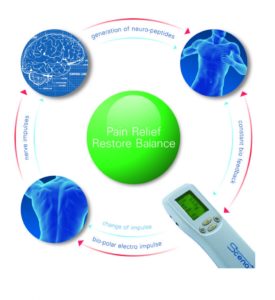
The SCENAR device is a small, hand-held device with transdermal electroneuro-stimulator, graphic display (Professional models), light emitting diodes (models for home use) and audible indications. It delivers non-invasive, computer-modulated therapeutic electro-stimulation via a patient’s skin and involves high amplitude, short-duration waveforms with little discomfort to patients. Due to this device’s high amplitude, small unmyelinated ‘C’ fibres can be stimulated to a higher degree than with other forms of electrotherapy. When sufficiently stimulated ‘C’ fibres trigger neuro- and regulative-peptide release with resultant pain relief and healing. The SCENAR impulse is carried via afferent nerve fibres to regulatory centres in the brain which in turn responds via efferent nerve fibres. SCENAR interprets this response and, via computer modulation, results in its next impulse being modified accordingly which further provides information back to the brain to either amplify or dampen the pathological signals initiating pain, ultimately leading to homeostasis. SCENAR therapy protocols include rating of pain, measurement of range of movement and testing of movement related to functional impairment.
The SCENAR device is small, portable, user-friendly, safe, and is relatively low-cost. Patients may benefit from faster recovery times, versatility and no concurrent medication interactions. The SCENAR has been cleared for marketing by the FDA for use in treating Chronic & Acute Pain.
Definition
RITM SCENAR® is an acronym for Self Controlled Energo-Neuro Adaptive Regulator.
SC – Self-Controlled The RITM SCENAR® device establishes a biofeedback connection with the body when in use, constantly changing the properties of the applied electric impulses, depending on the measured reaction from the body.
EN – Energo-Neuro The effect of RITM SCENAR® is based on electric impulses of a specific shape; patterned after the natural nervous discharges of the human body.
AR – Adaptive Regulator The RITM SCENAR® device not only provides direct therapeutic effect, but also activates the natural defenses of the body 1 2. The effect is achieved through
the stimulation of reflective zones and acupuncture points on the skin surface.
Overall, RITM SCENAR® is an effective, non-invasive medical technology, which works by stimulating the body’s inherent self-healing mechanisms. Its direct effect is several times stronger than other physiotherapeutic devices, with no undesirable side effects. 3 4 5 6 7 8.
- Gorodetskyi I G, Gorodnichenko A I, Tursin P S, Reshetnyak V K, Uskov, O N: Non-invasive interactive Neurostimulation in the post-operativerecovery of patients with a trochanteric fracture of the femur. J Bone Joint Surg [Br]2007;89-B:1488-94.
- G. Gorodetskyi et al, The effects of non-invasive, interactive Neurostimulation on pain and edema during post-surgical rehabilitation followinginternal fixation of unstable bi-malleolar ankle fractures, Presented as a poster by Dr James Dillard at the IASP 2008, Glasgow, Scotland. Accepted for publication Dec 2009, Journal of Foot and Ankle Surgery.
- Lee KH, Chung JM, Willis WD. Inhibition of primate spinothalamic tract cells by TENS. J Neurosurg. 1985; 62: 276-287
- Linda S. Chesterton, Nadine E. Foster, Christine C. Wright, G. David Baxter and Panos Barlas. Effects of TENS frequency, intensity and stimulation site parameter manipulation on pressure pain thresholds in healthy human subjects Pain, Volume 106, Issues 1-2, November 2003, Pages 73-80
- Garrison DW, Foreman RD: Effects of prolonged transcutaneous electrical nerve stimulation (TENS) and variation of stimulation variables on dorsal horn cell activity, Eur J Phys Med Rehabil 6:87-94, 1997
- Reilly JP, Applied Bioelectricity: From Electrical Stimulation to Electropathology, 1998 Springer-Verlag NY. pg 130 and 233.
- Christie Q. Huang, Robert K. Shepherd Reduction in excitability of the auditory nerve following electrical stimulation at high stimulus rates: Varying Effects of electrode surface area Hearing Research 146 (2000) 57-71.
- Pyne-Geithman G, Clark J F, InterX elicits significantly greater physiological response than TENS: Lymphocyte metabolism and Cytokine production. Presented as a poster at IASP 2010, Montreal, Canada. Aug. 29th 2010.