

Chronic low back pain is a major public health problem in the twenty-first century, on the physical, psychological, economic and social levels.
The latest HAS recommendations of 2019 take stock of multidisciplinary care.
From a therapeutic point of view, the treatment is complex and depends above all on the patient.
No therapy has shown optimal efficacy in improving VAS, taking analgesics or improving quality of life.
We therefore carried out a prospective study on the use of a nerve stimulation device SCENAR
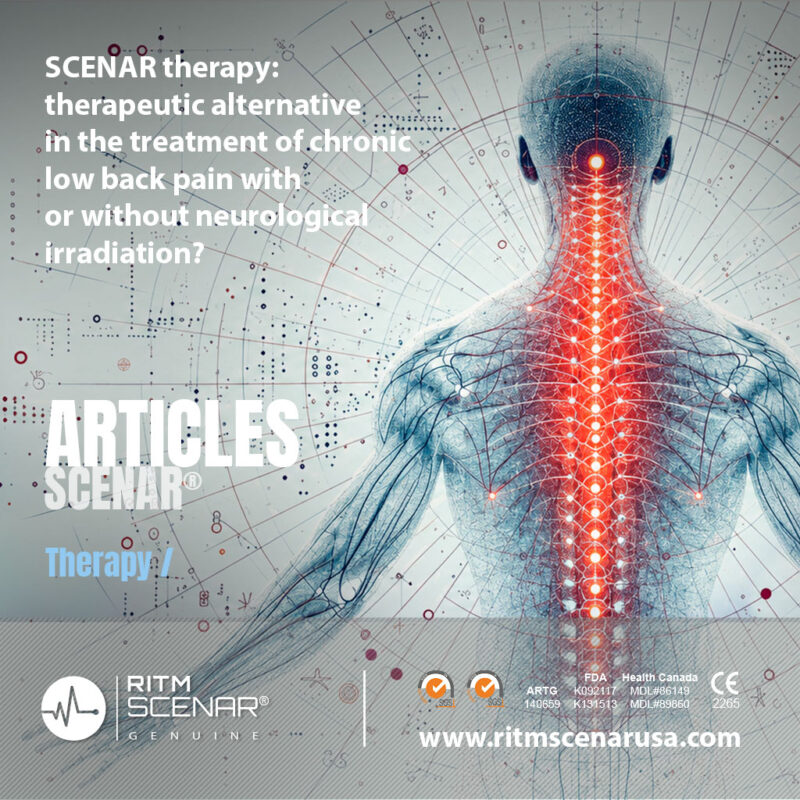
SCENAR therapy: therapeutic alternative in the treatment of chronic low back pain with or without neurological irradiation?
No Comments
by Arnaud Rosin,
translated and edited from University Doctorate Diploma December 18, 2020
Introduction
Chronic low back pain is a major public health concern in the 21st century, affecting patients physically, psychologically, socially, and economically. The 2019 recommendations of the French National Authority for Health (HAS) emphasize the importance of multidisciplinary management. Despite numerous available treatment options, no single therapy has consistently demonstrated optimal effectiveness in reducing pain, decreasing analgesic use, or improving quality of life.
To evaluate a potential alternative, we conducted a prospective study investigating the use of SCENAR therapy. SCENAR was approved for medical use in France in 2012. The device has been used at Poitiers University Hospital since 2013.
Methods
20 patients with chronic low back pain of 3 to 12 months’ duration, with or without radicular symptoms and no indication for spinal surgery, were enrolled following evaluation by a spine specialist.
Patients received SCENAR therapy according to the following treatment schedule:
- Day 0
- Day 7
- Day 14
- Day 21
- Day 28
- Month 2
- Month 3
Each treatment session lasted 30 minutes.
The primary outcome was the change in pain intensity measured by the Visual Analog Scale (VAS) from baseline (Day 0) to Day 28, Month 1, Month 2, Month 3, and Month 4.
Secondary outcomes included changes in analgesic medication use and health-related quality of life, assessed using the Nottingham Health Profile (NHP), at the same follow-up time points.
Results
Of the 20 enrolled patients, 6 were lost to follow-up:
- One patient underwent surgical treatment.
- Three patients were unable to continue because of disruptions related to the COVID-19 pandemic.
- Two patients withdrew from the study because they considered the treatment ineffective.
The final analysis included 14 patients. Statistical analysis was performed using the Wilcoxon signed-rank test, which is appropriate for paired data from small sample sizes.
Pain Intensity
Pain intensity, measured by the VAS, showed an overall reduction of 49% from baseline (Day 0) to Month 4.
Statistically significant improvements were observed:
- Day 0 vs. Day 28: p < 0.001
- Day 0 vs. Month 3: p = 0.0315
- Day 0 vs. Month 4: p = 0.0034
Quality of Life
Overall quality of life improved by 36% between Day 0 and Month 4.
Significant improvements were observed:
- Day 0 vs. Month 2: p = 0.033
- Day 0 vs. Month 3: p = 0.0155
- Day 0 vs. Month 4: p = 0.0322
Analgesic Medication Use
Analgesic medication use decreased by 67% between Day 0 and Month 4.
Statistically significant reductions were observed:
- Day 0 vs. Day 28: p = 0.0156
- Day 0 vs. M onth2: p = 0.0156
- Day 0 vs. Month 3: p = 0.0156
- Day 0 vs. Month 4: p = 0.0313
Discussion
Although improvements were observed in overall quality of life, changes within the individual subdomains of the Nottingham Health Profile did not reach statistical significance between baseline and Month 4.
A slight increase in analgesic use was noted as the interval between treatment sessions became longer, suggesting that maintenance therapy may be beneficial for some patients.
Importantly, both patients receiving morphine at baseline were able to discontinue opioid therapy during the course of the study.
Conclusion
This prospective study suggests that SCENAR therapy may represent a promising non-invasive treatment option for patients with chronic low back pain, with or without radicular symptoms. Patients experienced significant reductions in pain intensity and analgesic medication use, together with meaningful improvements in overall quality of life. Although these findings are encouraging, larger randomized controlled studies are needed to confirm the efficacy of SCENAR therapy and to determine its long-term role in the multidisciplinary management of chronic low back pain.
Human Medicine and Pathology. 2020. ⟨dumas-05501940v1⟩
Device has already been in use at the Poitiers University Hospital since 2013. Home – Site du CHU de Poitiers
More Similar Posts





You must be logged in to post a comment.